
Living a Creative Life in Times of Discomfort and Grief
By Helen Patterson
Do you believe that creativity belongs only to a chosen few, and that magnificent work is born exclusively from tortured souls, from the artist who suffers deeply and channels that suffering into something the rest of us can only admire from a distance?
This belief is still one of the most enduring myths around creativity itself. This month, as we explored ideas, innovation and the creative process, I found myself wanting to examine it more honestly. And as it turns out, life handed me my own curated challenge on this subject.
Creativity is not only born from suffering
As we looked at creativity in a broader sense this month, beyond the finished products, programs and polished presentations that make up the everyday fabric of working life, one question kept surfacing in the silence of my own exploration: does meaningful creation necessarily require pain? Or can it arise just as genuinely from a place of calm, sufficiency and inner peace?
Although the research suggests both can be true, I would like to focus on the brighter and more sustainable version here. There is actually a growing body of evidence pointing to a positive relationship between creative activities and mental health, explored thoughtfully in the paper Creative Expression and Mental Health by Ducel Jean-Berluche and what this work illuminates is something perhaps more nuanced than the suffering-artist myth allows for. Creativity is not just a consequence of pain, but can be a tool we reach for during pain, a way of moving through it rather than being defined by it. If anything, creativity may very well be the light we seek to turn on in the unnatural gloom of suffering. The yearning for light is also the yearning for love, hope, and healing.
Sharon Salzberg, writing about a panel discussion on this very topic, put it equally well: although suffering may often bring us to creative output, the opposite can also be true. A sense of inner peace, calm or sufficiency may do exactly the same thing. We can hold both of these truths at once.
What grief taught me about creation
In May, I lost my eldest sister Donna. Anyone who has experienced the particular weight of that kind of loss knows that it doesn't respect any type of schedule. The mountainous experience of loss moves through you in waves, and requires of you something strangely alien that ordinary life doesn't prepare you for.
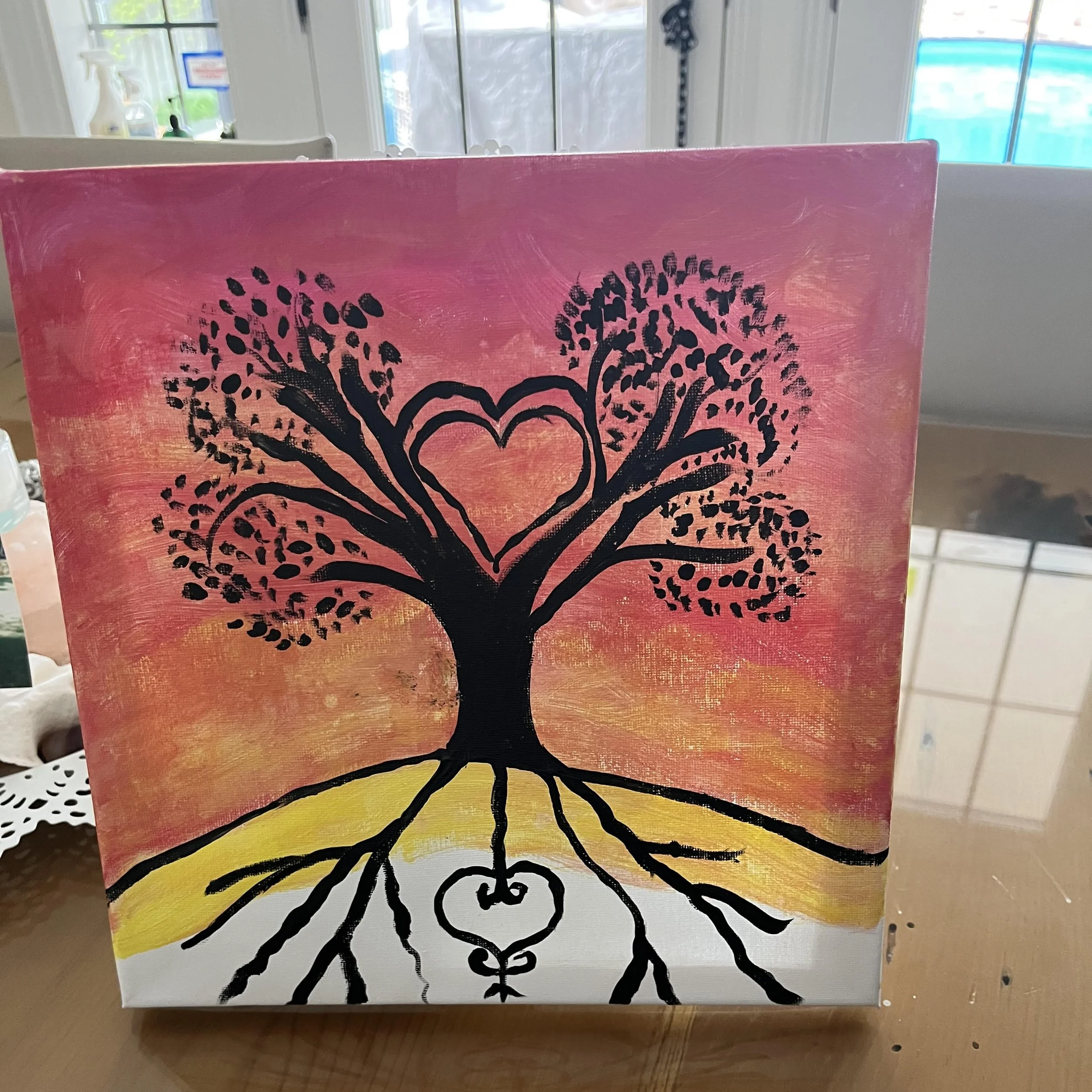
During that time, I found solace in the things I always return to, such as daily journaling, reading, writing. I also found unexpected healing in sound baths, in meditation, and in a painting session I hadn't even realised was part of one of those experiences until I was already in it, brush in hand, surprised by my own willingness to be there.
What I noticed, even though it remained subtle, was that by allowing creativity to move through me, the sorrow began to shift into a more active experience of grief. It didn’t disappear or lessen, but it somehow became an intelligent and purposeful vessel for transformation. That in itself allowed the sadness to soften into something closer to gratitude, for the memories, for the love, for everything that Donna was and continues to be in my life.
Creativity became the ritual around the burying, the liminal space that lives between loss and eternal love. It invited me to pass through the narrow trenches of pain before reaching a wider sense of acceptance.
Finding rhythm in the simplest things
A week after Donna's passing, I was scheduled to volunteer at a women's shelter. I almost didn't go, but I ended up keeping the commitment, and I am so glad I did.
While many of the volunteers tended to the garden, I was placed with the baking team. Let’s be clear, I am not a baker. But something about the simple, sequential act of following a recipe, measuring and mixing, making frosting from scratch, decorating cupcakes with an enthusiasm that compensated for my lack of skill, brought me to a deeper sense of stillness.
My sister actually loved to be in the kitchen. She loved desserts and meals made with care and shared generously. Being there, doing that, with the knowledge that women and their families who had recently left very difficult circumstances would enjoy what we made together, felt like one of the most profound creative experiences of my life.
Maybe that is what people mean by flow state. Maybe it’s actually that simple: to be at one with the true rhythm of life. To slow down when needed, to accelerate when life asks us to accelerate, to be both enthusiastic and still, peaceful and inspired. To be at one with our soul’s creative language.
What this means for the people we lead
My career in human relations has given me a long view on how workplaces have related to grief and difficulty. For decades, it was almost taboo to acknowledge loss at work, let alone offer meaningful support. Can you believe that three days of bereavement leave remains the standard in many organizations?
The good news is that the conversation is already shifting, and there are more resources available now, more openness to bringing the full human experience into working environments. And I believe the creative process has a real role to play in that.
When we create the conditions for people to move through their difficulties at their own pace, when we allow for the natural ebbs and flows of a human life, something interesting occurs. People often return to their work with fresh and more honest eyes, renewed in the depth of their perspectives and offering a quality of presence that cannot be manufactured, only embodied. Their best work may actually be waiting on the other side of being truly supported.
If life brings us to both heights and depths (which we can all agree is the very fabric of life), then I would suggest that during the heights, we are asked to generate ideas with energy and groundedness, while during the depths, the creative process can still surprise us, if we let it. We don't have to choose between being a person who creates and a person who grieves. We can be both, at the same time, carrying the intention to live an authentic life that lets itself be punctuated by creative curiosity and trust in the process.
An invitation
If you are moving through something difficult right now, I want to offer you a new lens on creativity: being creative is a birthright, not a talent, and it never asked you to produce anything extraordinary in the first place. If anything, it is just asking you to be bravely honest, entirely yourself, and to share your unique experience of life with the rest of us. It is asking you to show up to something, whatever that thing is, be it a journal page, a walk, a recipe, a conversation, and allow yourself to be present to it. Creativity is a passage, not a point to reach, and realizing that may be one of the most liberating ideas around living a creative life.
If you lead people, consider what it might mean to build that kind of space into the culture you're creating, inviting in a genuine acknowledgment that the people doing the work are whole human beings, with losses and longings and an innate creative capacity that doesn't disappear during hard times but waits patiently to blossom, if we give it a little room to breathe.
References
Jean-Berluche, D. (2024). Creative expression and mental health. ScienceDirect. https://www.sciencedirect.com/science/article/pii/S2713374524000098
Salzberg, S. (n.d.). Does creativity have to come from suffering? On Being. https://onbeing.org/blog/does-creativity-have-to-come-from-suffering/